
Introduction
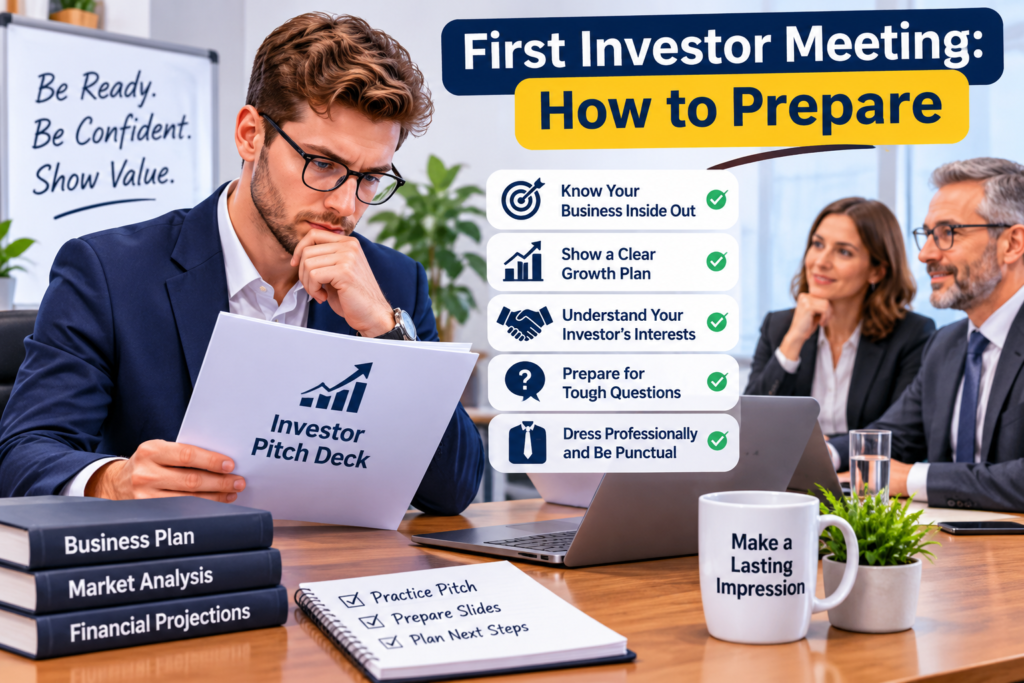
Preparing for your first investor meeting is an important milestone for any entrepreneur seeking external funding. It is an opportunity to introduce your business, explain its potential, answer important questions, and establish a professional relationship with people who may be interested in supporting its growth.
However, meeting with investors requires more than presenting a business idea or asking for financial assistance. Entrepreneurs must demonstrate a clear understanding of their businesses, financial requirements, market opportunities, and future objectives.
Investors want to see preparation, credibility, and a realistic approach to business development.
Whether you are approaching an individual investor, an investment group, or a venture capital organization, proper preparation can help you make a stronger impression.
In this guide, we explain how to prepare for your first investor meeting, what to bring, which questions to anticipate, and how to follow up professionally.
1. Research the Investors Before the Meeting
One of the biggest mistakes entrepreneurs make is approaching investors without understanding their investment interests.
Before your first investor meeting, take time to research the people or organization you will be meeting.
Find out:
-
What industries they are interested in
-
What types of businesses they typically consider
-
Whether they focus on startups or established companies
-
Their preferred investment stages
-
Their general investment approach
-
Whether their investment criteria align with your business
This research helps you determine whether your opportunity is relevant to their interests.
For example, an investor primarily interested in technology startups may not be the most appropriate audience for a traditional agricultural business.
Understanding the investor’s perspective also allows you to tailor your presentation and prioritize the information most relevant to the discussion.
2. Understand Your Business Thoroughly
Investors expect entrepreneurs to understand their businesses beyond what appears in a presentation.
During your first investor meeting, you may be asked questions that require you to explain your business model, operations, financial position, market, and competitive environment.
You should be able to explain:
-
What your business does
-
The problem it solves
-
Who your customers are
-
How it generates revenue
-
What makes it different
-
How it intends to grow
-
What challenges it currently faces
Avoid relying entirely on memorized statements.
A prepared entrepreneur should understand the reasoning behind the business strategy and be able to explain it naturally.
If you cannot clearly explain how your business operates, investors may question whether you are ready to manage the capital you are requesting.
3. Prepare a Professional Investor Presentation
A well-structured presentation can help guide the discussion and communicate your investment opportunity effectively.
Your presentation should cover the essential aspects of the business without overwhelming investors with unnecessary information.
Consider including:
-
Company introduction
-
Executive summary
-
Problem being addressed
-
Proposed solution
-
Market opportunity
-
Business model
-
Competitive advantage
-
Traction and achievements
-
Management team
-
Financial performance and projections
-
Funding requirements
-
Use of investment capital
-
Growth strategy
-
Potential risks
Keep your slides clear, professional, and easy to follow.
Your first investor meeting should be a discussion rather than a lengthy lecture. Leave room for questions and allow investors to explore areas that interest them.
4. Know Exactly How Much Funding You Need
One of the most important questions during an investor meeting is likely to be:
How much capital does your business need?
You should have a specific and well-supported answer.
Avoid estimating your funding requirement during the meeting or requesting an arbitrary amount simply because you believe more capital would be beneficial.
Prepare a funding breakdown that explains:
-
The total amount requested
-
Product development expenses
-
Equipment and infrastructure costs
-
Marketing and customer acquisition
-
Recruitment requirements
-
Operational expenses
-
Working capital
-
Contingency requirements
You should also explain what the funding is expected to accomplish.
For example, if you are requesting capital to expand production, identify the additional capacity the investment will create and how that capacity is expected to support revenue growth.
Investors want to understand the relationship between the capital requested and the business outcomes anticipated.
5. Organize Your Financial Documents
Financial transparency is essential when discussing a potential investment.
Before your first investor meeting, organize the financial information that supports your business proposal.
Depending on the company’s stage, this may include:
-
Historical financial statements
-
Income statements
-
Balance sheets
-
Cash flow statements
-
Revenue records
-
Expense breakdowns
-
Existing debt information
-
Financial projections
-
Funding requirements
-
Use-of-funds schedule
For early-stage businesses without extensive financial history, clearly distinguish actual financial results from projections.
Make sure your numbers are consistent across your presentation, financial documents, and verbal explanations.
You do not necessarily need to provide every document during an initial meeting. However, you should be prepared to share relevant supporting information when requested through an appropriate process.
6. Prepare for Difficult Investor Questions
A first investor meeting can involve challenging questions.
Investors may want to understand not only the strengths of your business but also its weaknesses, uncertainties, and potential limitations.
Some questions you should anticipate include:
About the business
-
What problem does your business solve?
-
Why did you decide to start this business?
-
What makes your solution different?
-
What stage is the business currently in?
About the market
-
Who are your main customers?
-
How large is your target market?
-
Who are your competitors?
-
What evidence demonstrates customer demand?
About the financial position
-
How does the business generate revenue?
-
What are your major operating costs?
-
Is the business currently profitable?
-
How did you calculate your financial projections?
About the investment
-
How much capital are you requesting?
-
How will the money be used?
-
What milestones will the investment support?
-
What investment structure are you proposing?
About risk
-
What are the biggest challenges facing the business?
-
What happens if revenue is lower than expected?
-
How do you intend to manage competition?
-
What could prevent the company from achieving its objectives?
Practice answering these questions clearly and honestly.
You do not need to know everything. If you do not have an answer, acknowledge it and explain how you would obtain the necessary information.
An honest response is better than an unsupported claim.
7. Demonstrate Your Knowledge of the Competition
Investors want to know whether you understand the environment in which your business operates.
Before your first investor meeting, identify the main competitors and examine how your company compares with them.
Be prepared to explain:
-
Who your direct competitors are
-
What alternative solutions customers use
-
How competitors position their products
-
Where your business has an advantage
-
What challenges you face in attracting customers
Avoid dismissing competitors or claiming that your business is automatically superior.
A realistic competitive analysis demonstrates that you understand the market and have considered how your company can establish a sustainable position.
8. Explain Your Growth Strategy
Investors want to understand what you intend to accomplish after receiving capital.
Your growth strategy should explain how the business plans to move from its current position toward its future objectives.
Depending on the business, this may involve:
-
Increasing production capacity
-
Expanding into new geographical markets
-
Introducing additional products
-
Improving operational efficiency
-
Investing in technology
-
Recruiting specialized employees
-
Developing strategic partnerships
-
Increasing customer acquisition
Support your growth strategy with realistic timelines and measurable milestones.
For example, rather than simply stating that the business intends to expand, explain which market it plans to enter, what resources are required, and how progress will be measured.
9. Prepare Supporting Documents
Although your presentation may provide an overview of the business, investors may request additional documentation to verify the information presented.
Organize important documents in advance.
Depending on the nature of your business, these may include:
-
Business registration documents
-
Ownership records
-
Shareholder agreements
-
Financial statements
-
Tax records
-
Business plans
-
Customer contracts
-
Supplier agreements
-
Licenses and permits
-
Intellectual property documentation
-
Product specifications
Keep your documents organized and ensure that the information is accurate and current.
You can also prepare a secure digital folder or data room for sharing relevant documents with authorized parties.
Sensitive financial, personal, and commercial information should be shared through appropriate secure channels.
10. Make a Professional First Impression
Your preparation should extend beyond the documents and presentation.
Professional conduct can influence how investors perceive your credibility and approach to business.
Consider the following:
-
Arrive on time.
-
Dress appropriately for the meeting.
-
Speak clearly and confidently.
-
Maintain a respectful and professional attitude.
-
Listen carefully to questions.
-
Avoid interrupting.
-
Keep your explanations focused.
-
Do not exaggerate achievements.
-
Be open to constructive feedback.
Confidence is valuable, but it should be supported by preparation and knowledge.
Your objective is not to impress investors through appearance alone. It is to demonstrate that you take your business and the investment discussion seriously.
11. Understand the Possible Outcomes of the Meeting
Not every investor meeting results in an immediate funding decision.
In many cases, the first meeting is simply an opportunity to establish initial interest and determine whether further evaluation is worthwhile.
Possible outcomes include:
Further discussions: The investor may be interested in learning more about the business.
Request for documentation: Additional financial, legal, or operational information may be required.
Due diligence: The investor may begin a more detailed investigation of the business.
Investment discussions: Both parties may explore possible investment structures and terms.
No immediate interest: The investor may decide that the opportunity does not align with their current investment criteria.
Entrepreneurs should approach the meeting with realistic expectations.
A request for additional information is not the same as an investment approval, just as an encouraging conversation is not a guarantee of funding.
12. Ask Investors Relevant Questions
An investor meeting should be a two-way discussion.
Entrepreneurs should also use the opportunity to understand the investor’s expectations and determine whether a potential partnership would be suitable.
Consider asking:
-
What industries or business sectors interest your investment group?
-
What factors are most important when evaluating opportunities?
-
What stage of business development do you typically consider?
-
What information would you need to assess our proposal further?
-
What role do you expect investors to play after investing?
-
How are potential investment structures usually evaluated?
-
What would the next steps be if there is mutual interest?
These questions demonstrate that you are thinking beyond the immediate funding request.
The objective should be to establish whether both parties have compatible expectations.
13. Follow Up After the Investor Meeting
Your responsibilities do not end when the meeting concludes.
A professional follow-up can help maintain communication and reinforce the positive impression created during the discussion.
After the meeting:
-
Send a brief thank-you message.
-
Reference important points discussed.
-
Provide any documents requested.
-
Clarify outstanding questions.
-
Confirm agreed next steps.
-
Respect the investor’s review process.
Avoid repeatedly contacting investors for immediate decisions.
Investment evaluation takes time, particularly when financial, legal, and operational due diligence is involved.
Professional communication and patience can help establish a productive relationship.
First Investor Meeting Checklist
Use this checklist to assess your readiness before attending your meeting.
I have researched the investor or investment group.
I can clearly explain what my business does.
I understand my target market.
I can explain my competitive advantage.
I have prepared a professional presentation.
I know exactly how much funding I need.
I can explain how the capital will be used.
My financial information is organized.
I have realistic financial projections.
I can answer difficult questions.
I understand the risks facing my business.
I have prepared relevant supporting documents.
I have questions to ask the investor.
I understand the possible next steps.
If several of these items remain incomplete, consider addressing them before arranging your first investor meeting.
The Crowd Project Fund Investor Perspective
At Crowd Project Fund, we believe that productive investment discussions begin with preparation, transparency, and a clear understanding of the business opportunity.
As an investor group, we recognize that every business has its own circumstances, challenges, and growth potential. Therefore, entrepreneurs should be prepared to explain not only what makes their businesses attractive but also the practical considerations involved in supporting their development.
A well-prepared entrepreneur should be able to communicate the company’s strategy, demonstrate financial awareness, explain its funding requirements, and provide credible answers to important questions.
We believe that a strong first meeting creates the foundation for meaningful evaluation. It allows both entrepreneurs and investors to determine whether there is sufficient alignment to proceed with further discussions.
Ultimately, the purpose of the meeting is not simply to request capital. It is to begin a professional conversation around a business opportunity that may justify further consideration.
Final Thoughts
Your first investor meeting can be an important step toward securing the resources needed to develop and expand your business.
However, making a strong impression requires more than enthusiasm. It requires a clear presentation, organized financial information, realistic expectations, and the ability to explain your business confidently.
Research the investors, understand your numbers, anticipate difficult questions, and prepare the documents that support your proposal.
Most importantly, remember that investment discussions involve mutual evaluation. While investors assess the business, entrepreneurs should also consider whether the potential investment partner is suitable for their long-term objectives.
With the right preparation, your first investor meeting can become the starting point for a valuable professional relationship.
-
First Investor Meeting: How to Prepare
-
Plastic Recycling Startup: Turning Waste into Economic Opportunity
-
3D Printing Startup: Transforming Ideas into Manufactured Products
-
Data Recovery Startup: Protecting Critical Digital Information
-
Waste Management Startup: Building Cleaner and Sustainable Communities
-
Pig Farming Business: Expanding Local Pork Production Sustainably