
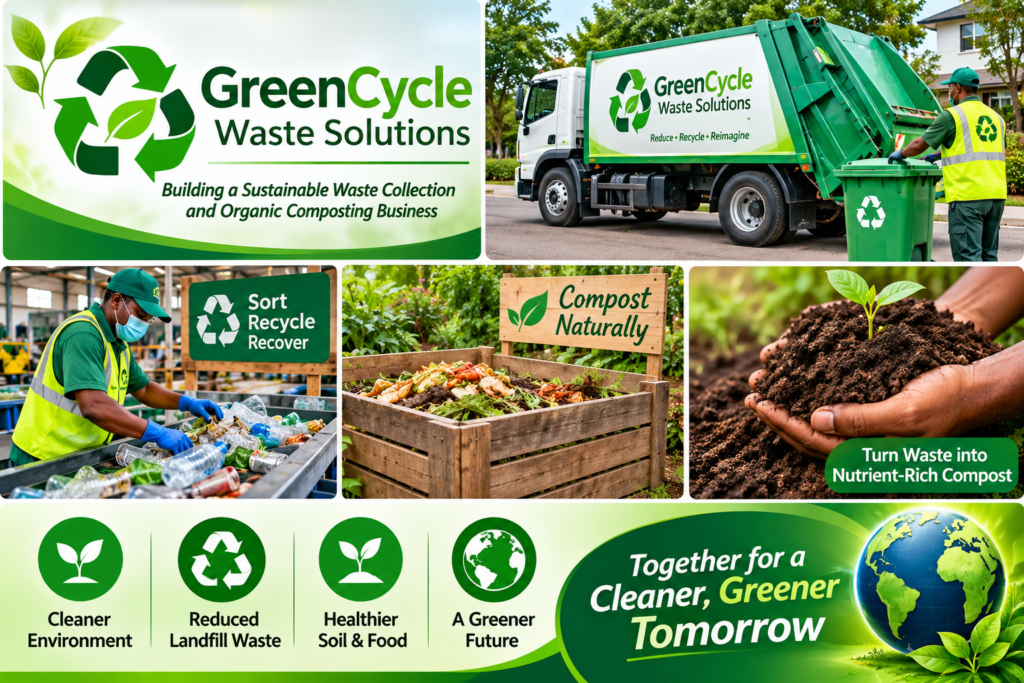
GreenCycle Waste Solutions: Building a Sustainable Waste Collection and Organic Composting Business
Turning Everyday Waste into Economic Value
Effective waste management is essential to maintaining healthy communities, protecting the environment, and supporting sustainable urban development. However, in many growing towns and cities, the increasing volume of household and commercial waste places considerable pressure on existing collection and disposal systems.
GreenCycle Waste Solutions is a proposed Waste Management Startup designed to address this challenge through organized waste collection, material sorting, and organic waste conversion.
Rather than operating solely as a traditional waste collection service, the business intends to develop an integrated system in which different categories of waste are recovered, processed, and redirected toward productive uses.
By combining commercial waste collection with compost production and recyclable material recovery, GreenCycle aims to establish a business model that generates income while contributing to cleaner communities.
The Market Opportunity: An Increasing Need for Organized Waste Services
Households, restaurants, supermarkets, hotels, markets, and office establishments generate substantial quantities of waste through their daily activities.
Unfortunately, inconsistent collection services and limited waste separation infrastructure can result in indiscriminate dumping, blocked drainage systems, unpleasant surroundings, and environmental contamination.
At the same time, agricultural producers require affordable soil improvement products, while recycling companies need reliable sources of recoverable materials.
These challenges create an opportunity for a Waste Management Startup capable of connecting waste generators with businesses that can reuse or process recovered materials.
GreenCycle intends to establish this connection through a structured collection and resource recovery system.
The Proposed Solution: An Integrated Waste Recovery Operation
GreenCycle will provide scheduled waste collection services to residential and commercial customers.
Its operational model will involve four major activities.
1. Organized waste collection
The company will introduce subscription-based collection arrangements for households, restaurants, shops, and other commercial establishments.
Customers will receive scheduled collection services based on agreed service plans.
2. Waste sorting and classification
Collected waste will be transported to a designated sorting facility, where recyclable materials, organic waste, and residual waste will be separated.
3. Organic compost production
Suitable organic waste, including selected food scraps and biodegradable plant materials, will undergo controlled composting.
The resulting compost will be screened and assessed for quality before being packaged and marketed to agricultural customers.
4. Recovery of recyclable materials
Materials such as plastic, cardboard, and metal will be separated and sold to appropriate recycling businesses.
Through this integrated approach, the Waste Management Startup aims to reduce the quantity of recoverable materials sent to disposal sites.
Target Customers and Revenue Opportunities
GreenCycle will serve several customer categories.
Its waste collection customers will include:
Residential communities and property managers.
Restaurants and hotels.
Supermarkets and retail establishments.
Offices and commercial buildings.
Markets and small business operators.
Its compost and recovered-material customers will include:
Smallholder farmers.
Agricultural cooperatives.
Plant nurseries and landscaping businesses.
Commercial farms.
Recycling companies and material distributors.
The business will generate revenue primarily through recurring waste collection subscriptions.
Additional income will come from selling processed compost and recyclable materials.
Over time, the company could introduce specialized waste collection contracts for commercial and institutional customers.
How CPF Financing Will Support the Project
GreenCycle requires investment in transportation, sorting infrastructure, processing equipment, and operational personnel.
CPF financing could support the following activities:
Acquisition of waste collection trucks and smaller collection vehicles.
Procurement of sorting equipment and storage containers.
Establishment of a waste processing and composting facility.
Acquisition of compost screening and packaging equipment.
Development of customer collection routes.
Recruitment and training of collection and processing personnel.
Implementation of waste tracking and customer management systems.
This support would enable the proposed Waste Management Startup to establish a more organized operating structure and gradually increase its service coverage.
Implementation Strategy and Operational Considerations
GreenCycle should begin by identifying areas with sufficient waste generation and potential demand for collection services.
The company should then secure collection agreements with households and commercial establishments before making major investments in additional vehicles and processing infrastructure.
The composting operation will require particular attention to waste quality, moisture levels, aeration, contamination control, and maturation periods.
Properly managed composting processes are essential to producing a safe and marketable agricultural product.
Several business risks should also be addressed.
Customer subscription retention: Reliable collection schedules and responsive customer service will help maintain recurring subscriptions.
Contamination of collected materials: Customer education and appropriate sorting procedures will improve material recovery.
Compost quality: Regular testing and appropriate processing standards will help maintain product consistency.
Transportation costs: Efficient collection routes and vehicle maintenance will be important for controlling operational expenses.
Environmental compliance: The company must obtain applicable permits and implement appropriate controls for leachate, odors, and residual waste.
Expected Economic and Social Impact
The proposed Waste Management Startup could create value beyond the direct provision of waste collection services.
Its projected benefits include:
Employment opportunities in collection, sorting, transportation, and compost production.
Cleaner residential and commercial environments.
Reduced pressure on existing waste disposal infrastructure.
Increased availability of locally produced organic soil improvement products.
Additional income opportunities for recyclable material collectors.
Improved public awareness of waste separation and responsible disposal.
The project could also support agricultural productivity by creating a market for properly processed compost.
Future Expansion and Business Growth
As its collection network expands, GreenCycle could introduce additional services, including electronic waste collection through qualified partners, commercial recycling programs, and specialized industrial waste management services where properly licensed.
The company could also develop digital customer platforms that allow subscribers to schedule collections, manage payments, and monitor service requests.
In the longer term, partnerships with municipalities, agricultural cooperatives, and manufacturing businesses could strengthen its commercial position.
Conclusion: Creating Value Through Responsible Waste Management
GreenCycle Waste Solutions presents an opportunity to transform waste management from a basic collection activity into a broader resource recovery business.
By integrating collection subscriptions, compost production, and recyclable material sales, this Waste Management Startup aims to establish multiple revenue streams while addressing important environmental challenges.
With appropriate financial support, operational discipline, and strong customer relationships, the project could develop into a scalable enterprise that contributes to cleaner communities and more sustainable resource utilization.
For CPF Financed, GreenCycle illustrates the investment potential of businesses that turn everyday environmental challenges into structured commercial opportunities.