
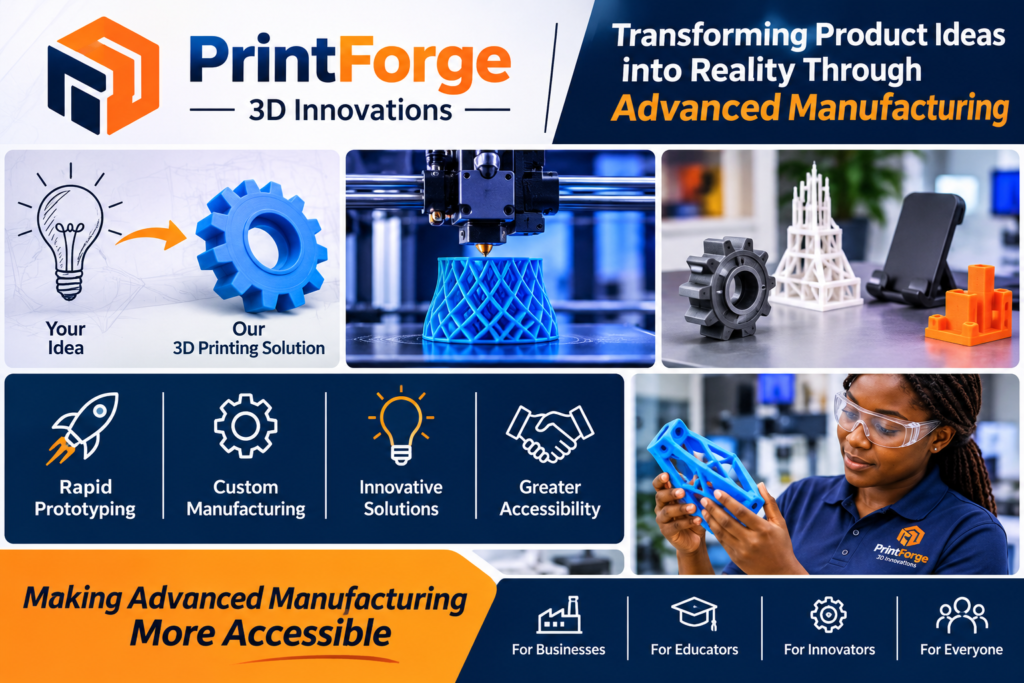
Making Advanced Manufacturing More Accessible
Innovation often begins with an idea. However, transforming an idea into a physical product can be expensive and time-consuming, particularly for entrepreneurs and small businesses that lack access to advanced manufacturing facilities.
Traditional manufacturing processes may require expensive molds, specialized tooling, and substantial production commitments before a new product can be tested.
PrintForge 3D Innovations is a proposed 3D Printing Startup designed to address this challenge by making digital product design, rapid prototyping, and on-demand manufacturing services more accessible.
The company plans to establish a specialized 3D printing facility where entrepreneurs, engineers, designers, educational institutions, and manufacturers can transform digital concepts into physical prototypes and selected functional components.
Through this approach, PrintForge aims to reduce barriers to product development while supporting innovation and local manufacturing.
The Business Opportunity: Closing the Gap Between Design and Production
Many promising product ideas never reach the market because developing an initial prototype can be costly.
Small manufacturers may also struggle to obtain specialized replacement components, particularly when importing them involves long delivery periods or minimum order requirements.
At the same time, educational institutions and engineering professionals increasingly require practical tools for product design, technical experimentation, and prototype development.
These challenges create an opportunity for a 3D Printing Startup capable of providing flexible production services without requiring customers to invest in their own manufacturing equipment.
PrintForge intends to serve this market by offering professional design assistance, prototype production, and customized 3D printing services.
The Proposed Solution: An Accessible 3D Printing and Prototyping Facility
PrintForge will establish a production facility equipped with desktop and professional-grade 3D printers, digital design workstations, and supporting tools.
Its operations will focus on several service categories.
1. Rapid product prototyping
Entrepreneurs and product developers will be able to submit digital designs for conversion into physical prototypes.
This will allow them to evaluate product dimensions, appearance, assembly, and selected functional characteristics before committing to larger production processes.
2. Customized product manufacturing
The company will produce customized items such as product enclosures, display components, architectural models, educational models, and selected accessories.
3. Replacement components
Where materials, specifications, and safety requirements permit, PrintForge will manufacture selected replacement components for machinery, equipment, and other applications.
4. Engineering and design support
Customers without advanced digital design experience will be able to access assistance with preparing or modifying printable 3D models.
5. Small-batch production
The facility will support businesses requiring limited quantities of specialized products without the cost of traditional tooling.
Through these services, the 3D Printing Startup will position itself as a manufacturing partner rather than simply a printing equipment operator.
Target Market and Revenue Model
PrintForge will target customers across several industries.
Potential clients include:
Product development startups.
Engineering and design firms.
Architects and construction professionals.
Educational and technical institutions.
Small manufacturing businesses.
Entrepreneurs developing consumer products.
Maintenance and equipment service providers.
Its main revenue source will be fees charged for 3D printing services.
Additional revenue opportunities will include design and modeling services, prototype development packages, customized production contracts, and training workshops.
The business could also develop recurring relationships with engineering companies and manufacturers requiring regular prototype or component production.
The proposed 3D Printing Startup will use a quotation-based pricing system that considers material consumption, machine operating time, design complexity, finishing requirements, and production volume.
How CPF Financing Will Support the Project
Establishing a professional 3D printing facility requires investment in equipment, software, production materials, and technical expertise.
CPF financing could support:
Acquisition of professional 3D printers.
Procurement of computers and design workstations.
Purchase of licensed computer-aided design software.
Acquisition of printing materials and consumables.
Establishment of a dedicated production and finishing facility.
Recruitment of qualified designers and machine operators.
Development of quality control procedures.
Initial operational and business development expenses.
This investment would help PrintForge establish the infrastructure necessary to serve customers requiring professional prototyping and customized production.
CPF’s support would illustrate the role of startup financing in introducing innovative manufacturing services into markets where access to such technology may be limited.
Implementation Strategy and Risk Management
PrintForge should begin by identifying the most commercially attractive applications for its equipment.
Rather than attempting to serve every possible industry immediately, the company could initially focus on prototype development, architectural models, educational applications, and selected low-risk replacement components.
It should establish clear technical procedures covering digital design validation, material selection, printing, finishing, and product inspection.
Several risks should be considered.
Equipment limitations: Different printing technologies support different materials, dimensions, and applications. The company must select equipment according to demonstrated customer needs.
High operating costs: Efficient material use, preventive maintenance, and careful scheduling will help control production expenses.
Inconsistent product quality: Standardized printing parameters, quality inspections, and technical training will be essential.
Limited customer awareness: Demonstrations, educational partnerships, and product development workshops can help introduce the technology to potential customers.
Intellectual property concerns: Customer designs and proprietary product information must be protected through confidentiality agreements and secure file management.
Safety and product suitability: Components intended for structural, medical, electrical, or other safety-critical applications must meet applicable technical and regulatory standards. Not every 3D-printed component is suitable for these uses.
Expected Economic and Social Impact
The proposed 3D Printing Startup could contribute to technological development and local manufacturing capacity.
Its expected benefits include:
Creation of skilled employment in design, engineering, and manufacturing.
Increased access to rapid prototyping services.
Reduced development costs for selected product concepts.
Support for entrepreneurship and technical innovation.
Improved practical learning opportunities for students.
Development of local solutions for selected manufacturing needs.
By making specialized equipment accessible through a service-based model, PrintForge could support businesses that would otherwise be unable to justify purchasing their own 3D printers.
Future Growth Opportunities
After establishing its initial customer base, PrintForge could expand into additional printing technologies and materials.
The company could also develop partnerships with universities, technical schools, engineering firms, manufacturing companies, and innovation hubs.
Longer-term opportunities may include industrial prototyping, specialized production services, digital product design training, and collaborative product development programs.
As customer demand becomes clearer, the business could expand its equipment capacity and introduce additional production capabilities.
Conclusion: Investing in the Future of Local Manufacturing
PrintForge 3D Innovations demonstrates how advanced manufacturing technology can create opportunities for entrepreneurs, engineers, and businesses seeking more accessible product development services.
By combining rapid prototyping, customized production, and technical design support, this 3D Printing Startup aims to establish a flexible manufacturing enterprise capable of supporting innovation across multiple industries.
With strategic financing, appropriate equipment, and strong technical management, the project could help reduce barriers to product development while contributing to local manufacturing growth.
For CPF Financed, PrintForge represents an illustrative opportunity to support technology-driven entrepreneurship and invest in a business model that connects innovation with practical commercial applications.
-
3D Printing Startup: Transforming Ideas into Manufactured Products
-
Data Recovery Startup: Protecting Critical Digital Information
-
Pig Farming Business: Expanding Local Pork Production Sustainably
-
Waste Management Startup: Building Cleaner and Sustainable Communities
-
Plastic Recycling Startup: Turning Waste into Economic Opportunity