
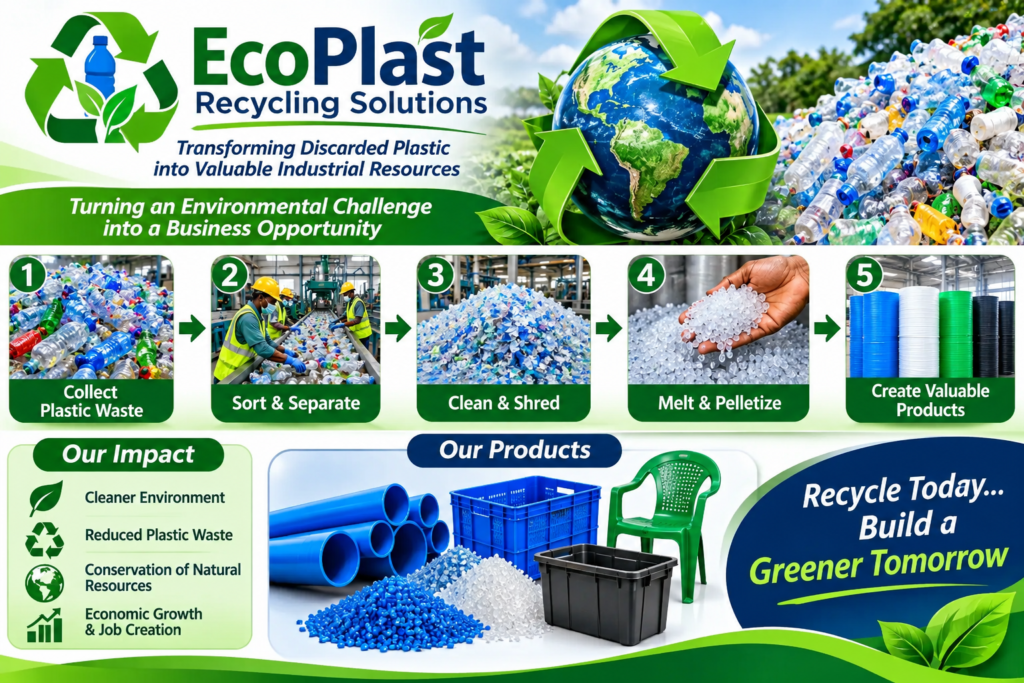
EcoPlast Recycling Solutions: Transforming Discarded Plastic into Valuable Industrial Resources
Turning an Environmental Challenge into a Business Opportunity
Plastic pollution remains a significant environmental challenge in many developing economies. From discarded water bottles and food containers to industrial packaging materials, plastic waste continues to accumulate in communities, drainage systems, and public spaces. However, what is often considered an environmental burden can also represent an untapped economic opportunity.
EcoPlast Recycling Solutions is a proposed Plastic Recycling Startup designed to address this challenge by transforming discarded plastic materials into reusable industrial raw materials. Through an organized collection, sorting, and processing system, the business aims to create commercial value from materials that would otherwise contribute to environmental pollution.
The project presents an opportunity to combine environmental sustainability with profitable manufacturing activities, while supporting the development of a more circular economy.
The Business Opportunity: Addressing Plastic Waste Through Innovation
The growing consumption of packaged products has increased the volume of plastic waste generated by households, commercial establishments, and manufacturing businesses.
Unfortunately, many communities lack adequate recycling infrastructure. As a result, substantial quantities of recyclable plastic materials are either improperly disposed of or remain unused.
EcoPlast intends to address this gap by establishing a structured recycling operation that connects waste collectors, households, businesses, and industrial buyers.
Rather than treating discarded plastics as unwanted materials, the proposed Plastic Recycling Startup will view them as valuable production inputs.
The business will initially concentrate on commonly recyclable plastics, particularly PET bottles and selected HDPE materials, subject to appropriate sorting and processing requirements.
The Proposed Solution: From Plastic Waste to Reusable Materials
EcoPlast plans to establish a recycling facility equipped with machinery for processing collected plastic materials.
Its operations will follow several stages:
1. Plastic waste collection
The company will establish collection partnerships with households, restaurants, retail establishments, waste collectors, and community organizations.
2. Sorting and classification
Collected materials will be separated according to plastic type, quality, and suitability for processing. Contaminated and unsuitable materials will be isolated for appropriate handling.
3. Washing and shredding
Suitable plastics will undergo cleaning to remove contaminants before being processed into smaller flakes through industrial shredding equipment.
4. Processing into reusable pellets
Depending on the material and available processing technology, cleaned plastic flakes will undergo extrusion and pelletization to produce recycled plastic granules.
5. Distribution to industrial buyers
The finished materials will be marketed to manufacturers requiring recycled plastic inputs for approved production applications.
Through this process, the Plastic Recycling Startup aims to establish a dependable supply chain between waste recovery and industrial manufacturing.
Target Market and Revenue Model
EcoPlast will target several categories of customers:
Plastic product manufacturers.
Packaging and container producers.
Construction material manufacturers.
Industrial recycling material distributors.
Businesses seeking recycled raw materials.
The company’s primary revenue stream will come from selling processed plastic flakes and recycled pellets.
Additional revenue opportunities may emerge through contracted collection services, material recovery partnerships, and customized recycling arrangements with commercial clients.
The proposed Plastic Recycling Startup will prioritize securing recurring industrial buyers before significantly expanding production capacity.
How CPF Financing Will Support the Project
Establishing a recycling facility requires considerable investment in machinery, operational infrastructure, and logistics.
Illustratively, CPF financing could support:
Acquisition of industrial plastic shredders.
Installation of washing and drying equipment.
Procurement of extrusion and pelletization machinery.
Development of collection and sorting facilities.
Purchase of collection vehicles and transportation equipment.
Recruitment and technical training of employees.
Initial procurement of operational supplies.
The financing would help EcoPlast move from a small-scale waste collection concept toward a structured industrial recycling operation.
CPF’s involvement would also provide an opportunity to support a business whose commercial activities contribute to environmental sustainability.
Implementation Strategy and Risk Management
The project would benefit from a phased implementation approach.
Initially, EcoPlast should establish its collection network, identify reliable suppliers, and secure agreements with potential industrial buyers. The company can then introduce processing equipment in stages as supply and demand become more predictable.
Several risks must be considered.
Inconsistent raw material supply: The company should establish multiple collection partnerships to avoid depending on a single supplier.
Fluctuating market prices: Long-term supply agreements and diversified buyers could help reduce exposure to changes in recycled material prices.
Equipment maintenance: Technical training and preventive maintenance programs will be necessary to minimize production interruptions.
Environmental compliance: The business must implement appropriate wastewater management, worker safety, and waste disposal procedures.
Expected Economic and Environmental Impact
The proposed Plastic Recycling Startup could contribute to environmental protection while creating commercial opportunities.
Its expected benefits include:
Creation of employment in collection, sorting, transportation, and processing.
Reduced quantities of recyclable plastic entering disposal sites and the environment.
Increased availability of recycled industrial raw materials.
New income opportunities for independent waste collectors.
Support for local manufacturing through alternative material sourcing.
These outcomes would depend on successful implementation, market demand, and the company’s ability to maintain consistent production standards.
Future Growth Opportunities
Once its initial operations become established, EcoPlast could expand into additional plastic categories and increase its processing capacity.
The business could also explore partnerships with packaging manufacturers, beverage distributors, municipalities, and environmental organizations.
In the longer term, the company could introduce traceability systems that allow commercial customers to monitor recovered plastic volumes and document their recycled material sourcing.
Conclusion: Investing in a Cleaner and More Productive Future
EcoPlast Recycling Solutions demonstrates how environmental challenges can inspire commercially viable business opportunities.
By connecting waste collection with industrial manufacturing, this Plastic Recycling Startup seeks to create value at multiple stages of the recycling chain.
With appropriate financing, operational planning, and access to reliable markets, the project could develop into a sustainable enterprise capable of generating revenue while contributing to environmental improvement.
For CPF Financed, the project represents an illustrative example of how strategic startup financing can support businesses that combine commercial ambition with measurable environmental and economic value.